

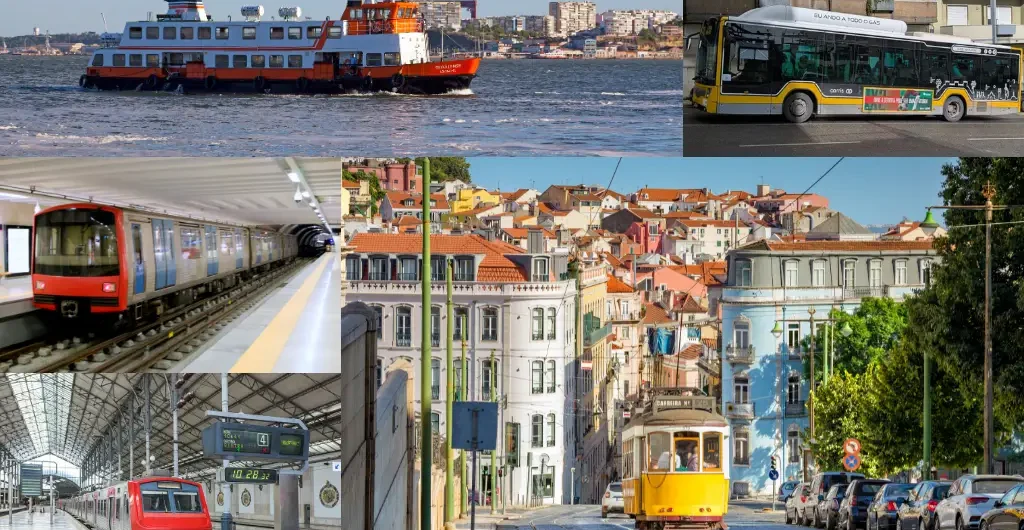
Discover all about public transport in Lisbon
Want to use public transport in Lisbon during your stay? We got you covered! This complete guide, updated to 2026, will explain to you how the metro, trains, buses, trams, and ferries in Lisbon work.
You’ll also find out how you can use public transport to reach some main attractions you might be interested in. Let’s get to it!
In a glance
- Navegante® Card
- Lisbon Metro
- Lisbon Trams
- Lisbon Buses
- Trains
- Lisbon Ferries
- Other ways of getting around in Lisbon
- Lisboa Card
- Extra Tips
Navegante® card
Even though there’s been an effort to roll out systems that allow you to tap in using your bank card, they aren’t yet in place everywhere. Moreover, you usually need to have one bank card per person, which might not be ideal if you’re travelling with kids.
So, before we dive into the complete guide to public transport in Lisbon, we want to explain how the navegante® card works, since you’ll need it to buy your tickets.
The navegante® system is divided into two options: the personalized and the occasional card. The personalized card contains the owner’s photo and name, and it’s used by locals to charge their monthly transportation passes.
The occasional option is a standard card that can be used throughout several forms of transport in order to buy tickets. It costs 50 cents and is reusable for up to 1 year. It’s also worth noting that the card is somewhat non-transferable.
For instance, imagine a family of three who wants to get a ticket from Lisbon to Sintra. Every member of the family who pays needs to have a navegante® occasional card with a ticket loaded onto it.
You can buy the navegante® card at any of the automatic machines or ticket booths when you go to purchase a trip.
NOTE: Long-distance train travel tickets aren’t loaded onto the navegante® card.
Lisbon Metro
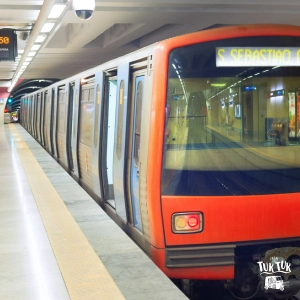
Compared to other European capitals, Lisbon doesn’t have the most extensive metro network. If you’re used to navigating large metro systems, you’ll find Lisbon’s quite simple. If not, don’t worry, we’re here to help!
Currently, there are four lines, each identified by a color:
- Blue Line: Runs from Reboleira to Santa Apolónia. This is the most useful line for visitors, as it connects major tourist spots like Marquês de Pombal, Avenida da Liberdade, Restauradores, Chiado, and Praça do Comércio.
- Yellow Line: From Odivelas to Rato, it mainly serves daily commuters.
- Red Line: Links Lisbon Airport to São Sebastião. If you’re planning to use public transportation to go to and from the airport, you might need to use this line. (More details on that below 😉)
- Green Line: Runs from Telheiras to Cais do Sodré. Like the yellow line, it’s mostly used by commuters, but if you’re planning to visit Cascais, you might need to use this line to reach Cais do Sodré.
Tickets Lisbon Metro
As of 2026, a single metro ticket costs €1.90. It’s valid for 1 hour and allows unlimited travel across the metro and bus/tram network during that time.
To buy your metro tickets, you can use the automatic machines present at the stations. Some stations have ticket counters available, but most often you’ll need to use the machines.
Ever since 2023, the Lisbon Metro has also supported contactless payments. This means that you can use your bank card to tap in and out of the metro. The ticket will be 1,92€, and the cards accepted are VISA, VPAY, and Mastercard.
If you’re planning on using this method, please be advised that you can only use one bank card per person. So, if you’re a family with kids, buying and charging the navegante® card might be the best option.
Places you can go with the Lisbon Metro
Now that you have a general view of how the Lisbon metro works, you need to know the places you can visit. As previously mentioned, the blue line covers some of the tourist areas in Lisbon, so you might find yourself needing to use it, especially if you, or someone you’re travelling with, has difficulty walking.
You can also use the metro to go to and from the airport. However, to reach Lisbon’s downtown area, you’ll need to switch lines either at the Alameda Station or at São Sebastião.
Switching in Alameda will get you access to Rossio and Baixa-Chiado, while switching in São Sebastião will get you access to Marquês de Pombal, Liberty Avenue, Restauradores, and Comércio Square.
Deciding which is the best option depends on the location of your hotel or apartment.
To switch lines, all you have to do is follow the signs that point to the line you’re transferring to.
If you don’t want to walk all the way to Cais do Sodré to catch the train to Cascais, a good option is to take the metro. The access station closer to downtown Lisbon is Baixa-Chiado or Rossio.
Got confused with all the station names? Check out the complete network map.
Accessibility
Most of the stations you might need during your stay are accessible to wheelchair users via elevators. However, unfortunately, the breakdown of the elevators is frequent, and there might be instances where there isn’t any elevator functioning. Given this, it’s best to check beforehand on the metro’s official website.
Useful Links
Official website | Ticket information | Network map | Accessibility information
Lisbon Trams

The trams are not only a means of transportation around the city, but also, for better or for worse, a tourist attraction.
The historic yellow trams have become an icon of Lisbon, and tram 28 has become famous as a cheap way to ride a historical vehicle while seeing some of Lisbon’s iconic streets. However, the fame got the best of it, and what started as public transport is now a fully packed tourist attraction that leaves locals stranded and visitors queuing for long hours.
Our honest advice? If you’re planning to ride Tram 28 just because it’s “a must-do,” think twice. You’ll see plenty of trams during your stay and can take great photos from the outside without spending hours waiting.
If you really want to see a historical tram up close and personal, you can always visit the Carris Museum. Tickets cost €4.50 for adults, and children under 6 enter for free. The museum showcases a fascinating collection of vintage vehicles, including the famous yellow trams.
If you wanted to take the tram for the scenic ride, opt for a tuk tuk tour or tourist tram ride. Both offer comfort and great views without the hassle.
Now, with all this said, there might be an instance where taking the tram makes sense, and that is when visiting Belém. You can hop on tram 15E at Comércio Square and exit either at the National Coach Museum, Jerónimos Monastery, or Belém Cultural Centre.
Tickets Lisbon Tram
A single ticket bought on board the tram will cost you 3,30€. On the older trams, the ticket can be bought directly from the driver. However, they only accept cash, and if you’re trying to pay with a high-value bank note, they might not have change.
On tram 15E, you can only pay via contactless card on the machines where you normally tap in. Physical cards from Visa, Maestro, or Mastercard are accepted, but you can also pay with your smartphone via Apple Pay, Google Pay, or other services.
Alternatively, you can load a single-use ticket onto your navegante® card, the same one used for the metro.
Accessibility
Unfortunately, wheelchair accessibility isn’t great aboard trams. According to the page on reduced mobility on the official website, none of the tram lines are fully accessible.
If you have limited mobility (but don’t use a wheelchair), note that Tram 15E has low floors, making boarding and exiting easier.
Useful links
Ticket information | 15E Timetable and route | Price Table
Lisbon Buses
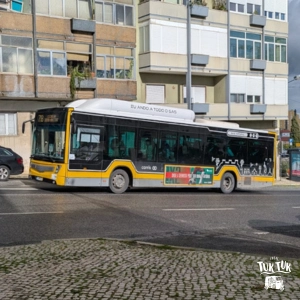
The buses that run in Lisbon’s city center are managed by a company called Carris, the same one responsible for the trams.
The bus network covers a large portion of Lisbon, making it a great option for exploring neighborhoods off the metro grid. The metro also closes at 1 AM and only re-opens at 6 AM, so if you find yourself in need of transportation after that, you can check out the night bus schedules.
The bus numbers also have a logic behind them:
- The lines that start with 7 (ex. 718) are the longer routes.
- The lines that start with 2 (ex. 201) are the night buses.
- The lines that only have 2 numbers are smaller routes. They can end in a B (ex. 19B), meaning neighborhood or shorter routes, or in an E (ex. 15E), meaning it’s a tram line.
Places you can go with the Lisbon Buses
For visiting Belém, the 728 and the 714 routes are a good alternative to the tram. The Ajuda and Alcântara neighborhoods are also places you might want to check out that don’t have a metro station nearby. So, you might want to consider taking the bus.
If you’re trying to get to and from the airport, the lines 744 and 783 are worth checking out for an alternative to the metro.
Extra tip: If you plan on going to Sintra and visiting any of the monuments, you can reach them via bus. The numbers are 434 and 435. These lines aren’t operated by Carris.
Tickets Lisbon Buses
A single bus ticket bought on board will cost you 2,30€. You can buy the ticket from the bus driver. However, they will only take coins or smaller bills.
Alternatively, just like on the trams, you can pay via contactless card onboard or charge the navegante® card.
Accessibility
Most buses are wheelchair-friendly, with dedicated spaces and ramps for boarding. Moreover, all the buses have lowered floors, ensuring that people with low mobility can move easily inside the bus.
Useful links
Ticket information | Price Table | Accessibility information
Trains
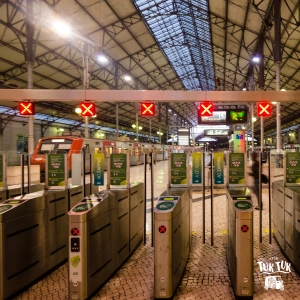
Catching the train is a great way to explore places around Lisbon. It’s quicker than the buses and will take you places the metro doesn’t reach.
Two companies operate passenger train lines in Portugal, CP and Fertagus. CP operates suburban and long-distance trains across Portugal, while Fertagus connects the two margins of the Tagus River.
Within the Lisbon Metropolitan area, CP has 4 suburban lines:
- The Sintra line is composed of 3 main routes: Sintra / Lisboa-Rossio, Sintra / Lisboa-Oriente, and Mira Sintra-Meleças / Rossio. If you’re planning on visiting Sintra during your stay, you’ll need to catch the Sintra / Lisboa-Rossio Line.
- The Cascais line does Cascais / Cais do Sodré. You might need to use this line if you want to visit Cascais or want an alternative route to Belém.
- The Sado line connects locations on the south side of the Tagus River. It runs from Praias do Sado-A to Barreiro, where the ferry then connects these places to Lisbon. It’s most used by commuters.
- The Azambuja line runs from Azambuja to Santa Apolónia, and like the Sado Line, it’s mostly used by commuters.
Fertagus only has one line that runs from Roma-Areeiro to Setúbal, crossing the 25th of April Bridge.
Places you can go with the Trains
By train, you can go to different tourist destinations like Oporto or Faro. If you have an extended period in Portugal, it might be worth considering splitting your visit between Oporto and Lisbon. To move between these two cities, you can use CP’s long-distance trains.
However, please note that long-distance trains are renowned for being late, so be sure to take this into account when planning your trip.
Day trips closer to Lisbon that you can take via train include Sintra, Cascais, or Setúbal.
To reach Sintra, you need to hop on the train in Rossio. You only need to exit at the last stop, so relax and enjoy the ride. When returning to Lisbon’s city center, you need to catch the Lisboa-Rossio train, not the Lisboa-Oriente. Double-check on the station screens that you’re getting on the right one. There are a lot of visitors who mistake the names and end up having to switch trains mid-journey.
To visit Cascais, first you need to reach the Cais do Sodré train station. It’s not that far from the city center, and you can use the walk to take in the sights. However, if you have limited mobility or prefer not to walk the distance, you can use the aforementioned metro or tram to get there.
Once in Cais do Sodré, you need to catch the train to Cascais. Once again, it’s the last stop, so take a seat and enjoy the train ride overlooking the Atlantic Ocean.
Another day trip you can take from Lisbon is Setúbal. The train departs from Roma-Areeiro station. This one is a bit harder to reach, since the metro (green line) doesn’t directly connect with the station, but you have an exit right at the top of the street. (Remember, you can catch the green line in either Rossio or Baixa-Chiado)
You also have the option to catch the Setúbal train in Campolide. To reach it, you can hop on the train at Rossio, exit at the first stop (Campolide), and then simply switch trains. If you go for this option, keep in mind you’ll need to buy two tickets: one for CP (Rossio – Campolide ride) and another for Fertagus (Campolide – Setúbal ride).
Another noteworthy mention is Belém. If the tram or buses don’t suit your needs, you can also reach it via train. You board at Cais do Sodré station and exit in Belém. Keep in mind that during rush hours (from 07h00 to 09h45 and from 17h00 to 20h15) there will be a train bound for Cascais that won’t stop in Belém. You’ll have to catch the one headed to Oeiras.
Train Tickets
CP’s train tickets are calculated based on the number of zones you cross to reach your destination. To have an idea, you can go to CP’s website and input your destinations. The page will then give you timetables and prices.
Fertagus’ tickets are also calculated based on the departure and arrival stations. In 2026, a train ticket from Lisbon to Setúbal will cost you 5,70€.
Most major train stations will have ticket booths and automatic machines available. However, there are some smaller stations, specifically on the Cascais line, where you only have automatic machines. To buy your ticket, you’ll need a navegante® card, which is available for purchase either at the booths or machines.
Accessibility
The trains in Portugal usually have a designated space for wheelchair users, and the entry is usually made via an adapted elevator. However, not all train stations are wheelchair-friendly and, sometimes, the elevators might not be properly functioning. If you’re planning to travel by train and need assistance, it’s best to call customer support.
CP: 808 100 746
Fertagus: 211 066 817
Useful links
CP Zone Map | Fertagus Line | CP accessibility information | Fertagus accessibility information
Lisbon Ferries
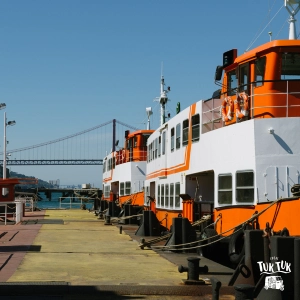
The ferries in Lisbon are operated by Transtejo Soflusa, and there are 5 connections:
- Cais do Sodré – Cacilhas
- Cais do Sodré – Seixal
- Cais do Sodré – Montijo
- Terreiro do Paço – Barreiro
- Belém – Porto Brandão – Trafaria
Most of them are commuter-related services that allow people to reach Lisbon from the south bank of the Tagus River. However, if you have the time, it might be worth checking out Cacilhas. Cais do Ginjal, a walkway right beside the Tagus River, will give you some great views over Lisbon.
Lisbon Ferry Tickets
The price for a single ticket on the Lisbon ferry varies according to the connection you choose. For Cacilhas, a single ticket will cost you 1,60€. Like the metro and train, you’ll need a navegante® card.
The tickets can be bought at the ticket booths or automatic machines.
Accessibility
Access to the ferries is usually made via a ramp to the entrance, so entry is quite simple for people with limited mobility or wheelchair users.
Useful links
Terminals and Stations operating hours | Network diagram | Lisbon Ferry Prices | Accessibility Information
Other ways to get around Lisbon
Taxis
Just like any other city, you can get around Lisbon using Taxis. In all likelihood, you’ll find them parked around major train stations or streets around Lisbon. If you can’t find or hail one on the street, you can always call. (Cooptáxis is a good bet with a website in English)
Although they won’t be cheaper than riding public transportation, they can be a good bet for people with severe mobility problems. It can also be a good way of reaching your hotel from the city center, especially if you’re on a later flight.
However, be aware of scams at Lisbon Airport. The prices are never based on a fixed rate arranged before the trip. So, if that’s offered, be wary.
The licensed taxis are usually black and green or beige.
Shared Scooters/Bikes
Another way to get around that has become quite popular among locals and tourists alike is the shared scooters and bicycles. You can find them scattered all around the city. The main companies are Bolt, Lime, and Bird.
There’s also one called GIRA that is run by the municipality of Lisbon.
Uber
Uber and other similar services are also available in Lisbon. They can be a bit of a cheaper alternative to taxis and more efficient since they come directly to your location.
If you’re thinking about calling an Uber from Lisbon airport, consider that they have designated places to stop, and you can only catch them there. It can get a bit confusing sometimes.
Tuk Tuk
Another alternative to getting around in Lisbon is the tuk tuks. Usually, the service is more sightseeing, with the driver also acting as a guide. However, companies also do transfers. It can be a fun and original way to get to your destination. Check out our tours and services, if you think this is the option for you.
Lisboa Card
Lisboa Card is Lisbon’s official tourist card that will give you free access to Lisbon’s transportation and upwards of 50 monuments. It will also give you discounts on a wide variety of monuments, museums, attractions, and tours. Check out the included attractions to see if any of your “want to do in Lisbon” are included.
The 72-hour card price for an adult is 62€, which might be worthwhile if you’re planning on visiting a lot of monuments. It also saves you the trouble of having to buy individual tickets for the places you want to go. You simply tap the Lisboa card and go.
The card can be bought online or at the Ask Me Lisboa desks. Bear in mind that if you purchase online, you’ll receive a voucher that you then have to redeem at the Ask Me Lisboa desks.
Extra Tips
- To avoid uncomfortable journeys, refrain from using public transportation during rush hours (Monday through Friday from 8-10 AM and 5-7 PM).
- Also, if you’re travelling with large suitcases, beware of the space they take and try to keep them away from the entrance and exit paths as much as possible.
- All public transport in Portugal has priority seating. Generally, these seats are closer to the doors and are marked accordingly. Be aware of that when choosing your seat.
- Be careful with pickpockets, especially if you’re travelling on a line frequently used by tourists. On full rides, it’s easy to lose a wallet or a phone without realizing it.
- The buses and trams don’t always have the screens that let you know where you are fully functioning. So you don’t get lost, follow the route on Google Maps.
- The metro doors open at every station and don’t need to be activated. However, train doors do. On the outside, you’ll find buttons that open the doors. On the inside, you’ll find either a button or a lever. On the buses and trams, you’ll need to signal that you want to enter and push the stop button before exiting.
- In public transportation, where there aren’t any barriers to entry/exit, you don’t need to tap out at the end of the journey. But please keep your ticket with you during the trip, as it might be requested by the ticket inspector. It’s also a good idea to keep the payment receipts in case the card malfunctions.
Conclusion
Public transport in Lisbon might seem a little daunting at first. However, there’s nothing to fear. With a navegante® card or the all-inclusive option of the Lisboa card, you can reach a lot of interesting places easily. The problem will be choosing what to do.
If you want a quick guided overview of the city to help you get to know the main attractions all in one go, check out our Lisbon Tuk Tuk tours. The guides will answer any transportation-related questions you may have that haven’t been covered here and share a wealth of historical and cultural information about the city.
If you’re just looking for a way to get around the city, share with us your itinerary, and we’ll find a way to get you where you want to go in a comfortable way.



Comments